
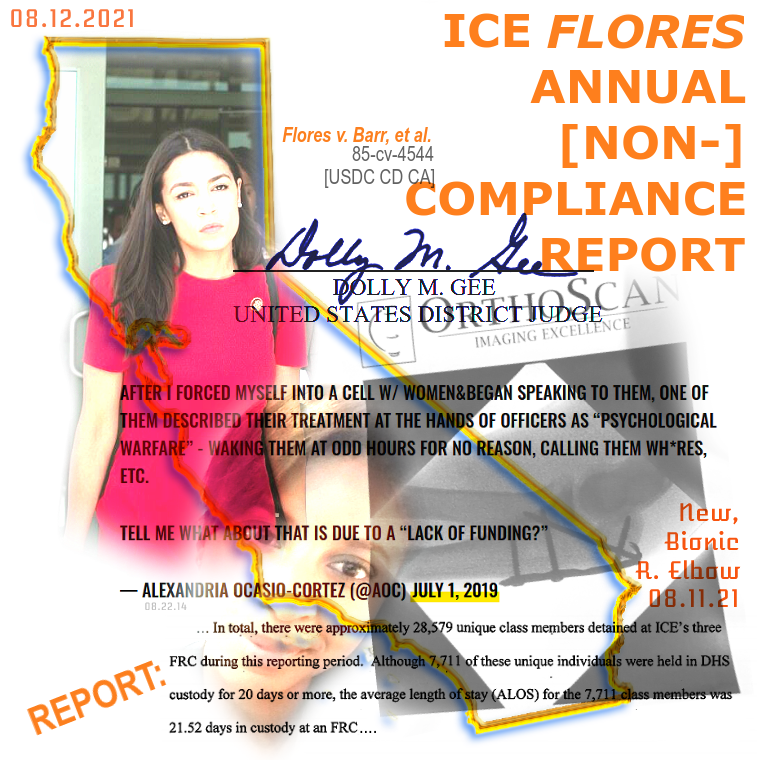
 This pushes things beyond the July 4 holiday weekend. Ugh.
But make no mistake: karma is coming for these goons, who refuse to give children soap, toothpaste, warm bedding and clean water, as well as healthy food, and outdoor rec time -- while being held at Dilley and other facilities.
These are. . . children -- what the actual. . . hell(?!):
. . .By this stipulation, and pursuant to Local Rule 7-1, the parties respectfully ask the Court to continue the deadline for Defendants to file a response to the Court’s Order to Show Cause (OSC) of June 15, 2026, ECF No. 1794, from June 25, 2026, to July 6, 2026, and that the deadline for Plaintiffs to file their response to the OSC be extended from July 6, 2026, to July 15, 2026. . . .
[And, in the Ms. L class litigation, overnight -- before the able USDC Judge Sabraw in San Diego:] [I]n Flores v. Garland, 3 F.4th 1145, 1147 (9th Cir. 2021), where the Ninth Circuit interpreted a landmark settlement agreement entered into by the United States in 1997 with a class of migrant minors subject to detention by U.S. immigration authorities (the “Flores Agreement”), and affirmed the district court’s order enjoining the Department of Homeland Security (“DHS”) from detaining for more than three days minors protected by the Flores Agreement who were housed in “twenty five hotels across three states[.]” Id. at 1148. There, the United States [Tangerine 1.0] did not advance the habeas argument presently argued by [Tangerine 2.0] Defendants here, and the Ninth Circuit did not require such an approach, i.e., a habeas action, let alone a habeas action in each district in which class members were detained. . . . [In that] historic settlement, [Tangerine 1.0] Defendants here agreed to robust relief for Ms. L. class members to address Defendants’ prior unconstitutional conduct and the harm caused by their family separation practices. . . .
As the Court noted in its prior Order: “[A]lthough it may be theoretically possible for Plaintiffs’ counsel to obtain information about the reason for their client’s detention form sources other than [Tangerine 2.0] Defendants, efforts to obtain that information from those sources is time-consuming and often unsuccessful. . . . As a matter of common courtesy and cooperation, and to ensure Class Members and QAFMs have full access [to] the benefits of the Settlement Agreement, the Court orders [Tangerine 2.0] Defendants to provide Plaintiffs’ Counsel with the requested information.” (ECF No. 937 at 8.) For the reasons set forth above, Defendants should not be detaining class and family members except for reasons justified under the Settlement Agreement. Where Defendants elect to detain class and family members, they must articulate those reasons to Plaintiffs’ Counsel as promptly as reasonably possible so counsel can expeditiously determine whether to seek relief from the Court under the Settlement Agreement. . . .
Dammit. Onward -- in anger. Again.
नमस्ते


No comments:
Post a Comment