

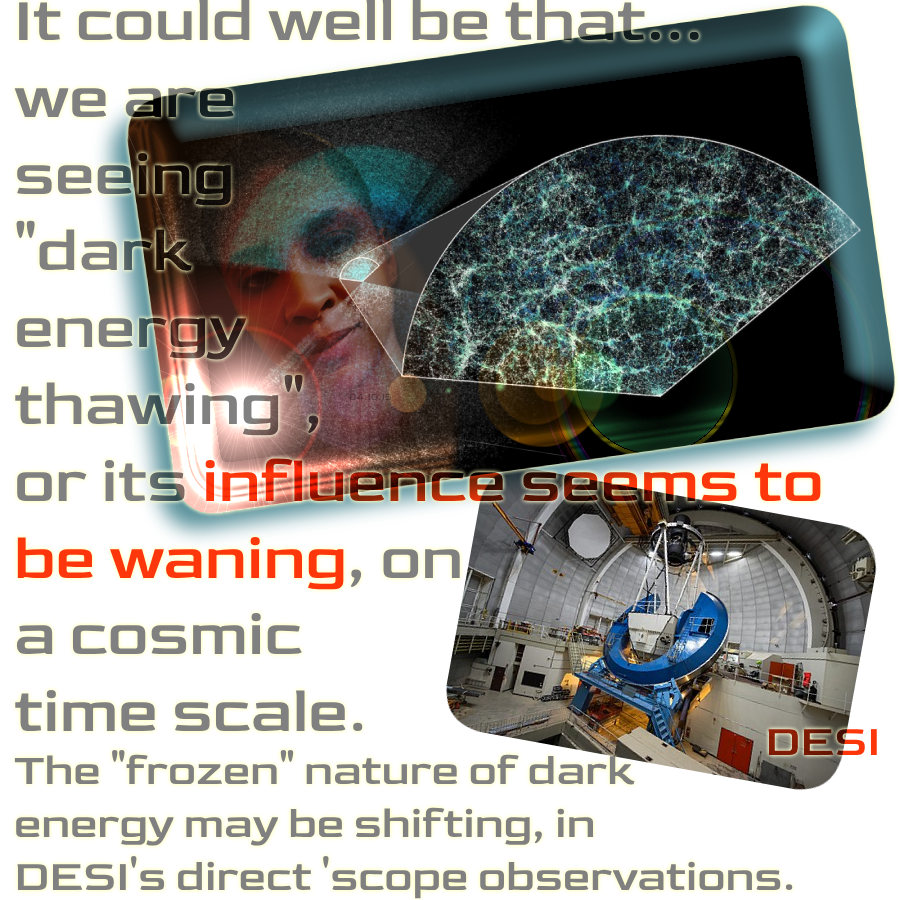
But now, a South Korean team has reached essentially the same conclusion that the Desi team reached in March of 2024: the speed at which several vastly distant supernovae are moving away from us seems to be decreasing. This in turn would imply that the very fabric of space itself is moving outward in all directions in a decelerating fashion, now over the last hundred million or so years.
And that would imply that some day in the vastly distant future, the universe will stop, reverse course, and begin to deflate, like a birthday party balloon after three or four nights. And then. . . at some even more vastly distant point in time, a "big collapse" will occur – giving rise to a new Big Bang. Here's that, from March 2024:
. . .Dark energy, the mysterious force powering the expansion of the universe, appears to be weakening, according to a survey that could “overthrow” scientists’ current understanding of the fate of the cosmos.
If confirmed, the results from the dark energy spectroscopic instrument (Desi) team at the Kitt Peak National Observatory in Arizona would have profound implications for theories about the evolution of the universe, opening up the possibility that its current expansion could eventually go into reverse in a “big crunch. . . .”
Onward, to check the dockets and see if I'll pop over (around 2 pm) to Judge Ellis's courtroom -- to see Bovino get his back porch painted bright red. Heh.
नमस्ते


No comments:
Post a Comment