
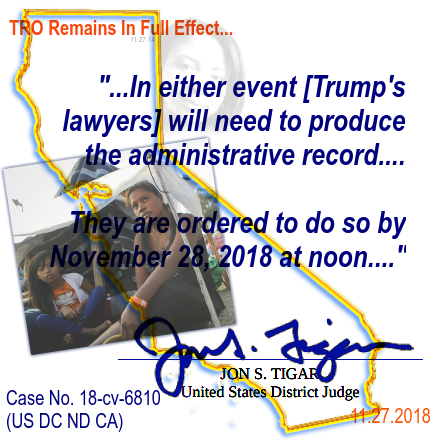
After Tangerine 2.0's inaugural, the political appointees in the office of the US Attorney ordered career federal government attorneys to file a brief in the Ninth Circuit, challenging (for the first time) the standing of the advocates for the asylum seekers, East Bay Sanctuary. The Ninth Circuit has asked the parties what should happen next -- whether it should remand to Judge Tigar to look for the first time at the question of standing (after the Supremes decided FDA v. Alliance for Hippocratic Medicine -- the 2024 case that said fundamentalist x-tian doctors groups cannot prevent a whole state, or nation, full of doctors -- from providing the abortion pill to people who use it to save their lives). That "what's next?" -- from the two sides response was filed this past week. Here is what we've just read about it -- and I think it is going back down to the trial court -- since the Trumpians raised standing:
. . .[R]emand is also appropriate so that the district court can consider in the first instance the impact of the termination of the so-called “lawful pathways” on the Rule’s legality and rationality. The Rule is titled “Circumvention of Lawful Pathways” and is explicitly premised on the existence of what it calls “orderly options for migrants to lawfully enter the United States.” 88 Fed. Reg. 31314, 31317 (May 16, 2023). The most prominent of these “pathways” were the CBP One system for scheduling appointments at southern border ports of entry and country-specific parole programs for Cuban, Haitian, Nicaraguan, and Venezuelan (“CHNV”) nationals. Id. The new [Tangerine 2.0] administration has now shut down these so-called “lawful pathways.” See Executive Order 14165 § 7(a)-(b), 90 Fed. Reg. 8467, 8468 (Jan. 20, 2025) (terminating the CBP One scheduling system and the CHNV parole programs). . . .
These developments go to the heart of whether the Rule is consistent with the asylum statute Congress enacted and whether the Rule is arbitrary and capricious. The stated rationale of the Rule is to incentivize asylum seekers to use the so-called “lawful pathways” by barring asylum to those who cross the southern border without CBP One appointments. See, e.g., Appellants’ Br. 1-2, 9-11, 37-38. And the existence of those “pathways” has been central to the [prior Biden Administration's] government’s defense of the Rule in this litigation. . . .
In Plaintiffs’ view, it is therefore appropriate for the parties to address how these developments impact the merits of this case. See, e.g., Dkt. Nos. 74, 77, 78, Las Am. Immigrant Advocacy Ctr. v. DHS, Case No. 1:24-cv-01702 (D.D.C.) (supplemental briefing concerning the impact of the termination of the CBP One system on the legality of a separate asylum restriction also premised on the existence of that system).
And the district court should consider the parties’ arguments on those issues in the first instance. See, e.g., Bafford v. Admin. Comm. of Northrop Grumman Pension Plan, 101 F.4th 641, 657 (9th Cir. 2024) (“As a general rule, a federal appellate court does not consider an issue not passed upon below.”) (cleaned up); NRDC, Inc. v. Winter, 513 F.3d 920, 922 (9th Cir. 2008). . . .

What a tangled ball of barbed wire Team Tangerine 2.0 makes of things -- by not even considering what federal law requires -- before he throws his spaghetti at the wall, to see what sticks. Ugh.
नमस्ते


No comments:
Post a Comment